
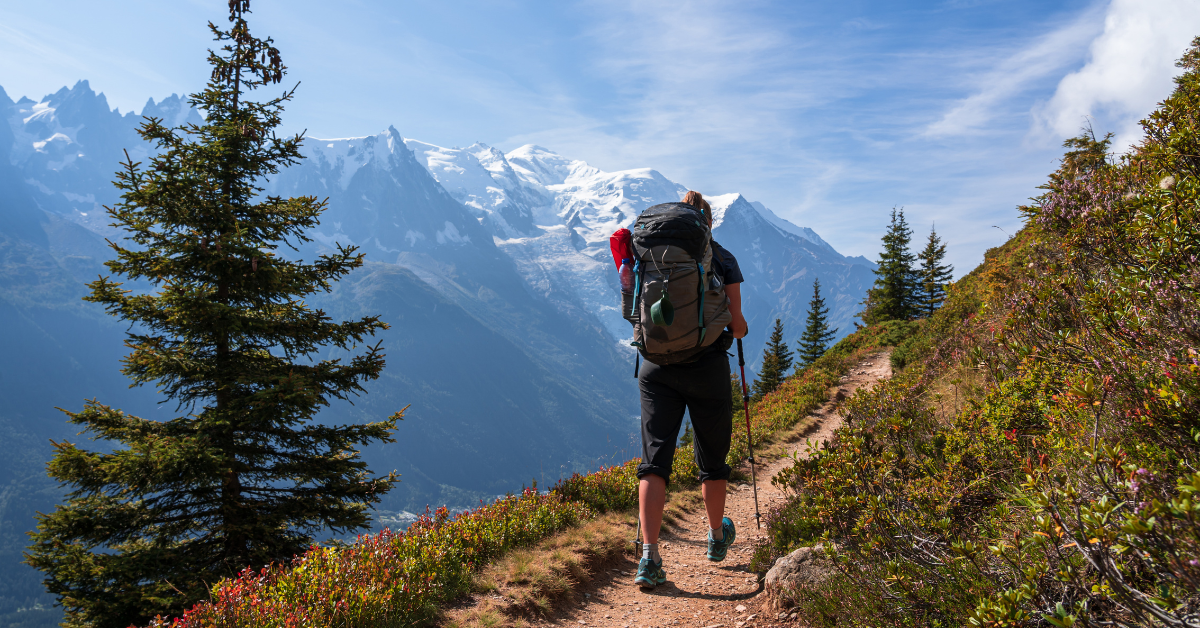
The Tour du Mont Blanc (TMB) is one of Europe's most iconic long-distance hiking trails. This spectacular 170-kilometer loop, spread over approximately 7 to 10 days, traverses three countries: France, Italy, and Switzerland. This route around the highest peak in Western Europe, Mont Blanc, offers a diverse range of exceptional alpine landscapes, from flowery valley meadows to rocky high-altitude passes. Accessible from Les Houches in Haute-Savoie, the Tour du Mont Blanc attracts thousands of hikers each year, drawn by both its breathtaking panoramas and the technical challenges it presents.
A Famous Hiking Trail Across Three Countries
Distance, Duration and Difficulty Level
The Tour du Mont Blanc is a demanding trek requiring good physical condition and serious preparation. At 170 km long and with over 10,000 meters of elevation gain , this major hike is not for beginners. While most hikers complete the circuit in 7 to 10 days, it is possible to adjust the duration depending on your pace and chosen routes. Some more technical or exposed sections can be bypassed, while others offer more spectacular alternatives for those who love high altitudes and panoramic views.
The start and finish are usually in Les Houches , a small town near Chamonix . Most hikers choose to hike this long-distance trail counter-clockwise, which allows them to climb the steepest slopes at the beginning and finish with more gradual descents.
Key Points of the Tour du Mont-Blanc
The Tour du Mont Blanc offers a succession of mountain passes, valleys, and mountain huts, each providing a different view of the Mont Blanc massif and its surrounding peaks. Among the most spectacular spots is the Col du Bonhomme , located at 2,329 meters altitude , offering a magnificent view of the Jovet lakes and the Contamines-Montjoie nature reserve. This pass is renowned for its breathtaking panorama of the Beaufortain region and the Roches Merles .
Another essential stop is the Col de la Seigne , marking the border between France and Italy, at an altitude of 2,516 meters . From this point, hikers can admire the Mont Blanc massif in all its splendor, with iconic peaks such as the Aiguille des Glaciers and the Aiguille Blanche de Peuteurey . This pass is also the gateway to the Val Vény , one of the most spectacular sections of this hiking trail .
Memorable Stages of the Tour du Mont-Blanc
The Col du Bonhomme and the Contamines Nature Reserve
The Col du Bonhomme is often considered one of the first significant stages of the Tour du Mont Blanc . Located at an altitude of over 2,300 meters , it lies in a wild and unspoiled area of the Contamines-Montjoie nature reserve . After a steady climb from the valley, hikers reach a high plateau offering unobstructed views of the surrounding peaks.
The Contamines nature reserve , with its Jovet lakes , adds a magical dimension to this section of the hiking trail . In summer, the alpine meadows are dotted with wildflowers, while the lakes reflect the surrounding mountains. This area is particularly appreciated for its tranquility and the diversity of its flora and fauna, offering a contrast to the rockier sections of the long-distance hiking trail .
The Col de la Seigne and the Val Vény
After crossing the Col du Bonhomme , the hike continues towards Italy via the Col de la Seigne . This pass, at 2,516 meters , is an iconic crossing point on the Tour du Mont Blanc , marking the border between France and Italy. It is also here that hikers discover the Val Vény , one of the most beautiful plateaus on the route. Overlooked by imposing peaks such as the Aiguille des Glaciers , Mont Percé , and the Aiguille Blanche de Peuteurey , this area offers spectacular views of the Alpine massif.
The descent into the Val Vény leads to the Elisabetta refuge , one of the many mountain huts scattered along the TMB . This refuge is an ideal place for a well-deserved break, with an unforgettable panorama of the surrounding peaks.
The Exceptional Panoramas of the Tour du Mont-Blanc
The Balcony of the Grandes Jorasses
One of the highlights of the Tour du Mont Blanc is the passage along the Grandes Jorasses balcony , a section of the trail offering breathtaking views of the Aiguille du Midi and the Grandes Jorasses . This part of the route is located between the Bertone refuge and the Bonatti refuge , two key stops for hikers undertaking the entire traverse.
The balcony trail offers a walk facing the immense rock faces of the Grandes Jorasses , one of the most formidable mountains in the Alps. This breathtaking panorama of glaciers and snow-capped peaks is one of the most beautiful on the entire Tour du Mont Blanc , attracting numerous photographers and mountaineering enthusiasts.
The Grand Ferret Pass
After leaving Switzerland, hikers on the TMB pass through the Grand Ferret pass , located at an altitude of 2,537 meters , offering an impressive view of the Italian and Swiss Alps . This passage between the Swiss and Italian Val Ferret marks the transition to the final section of the trail .
From the Grand Ferret pass , hikers have a breathtaking view of the glaciers of the Mont Blanc massif and can glimpse the villages of La Fouly and Courmayeur below. The pass also offers an exceptional view of the Grandes Jorasses , and the descent into the Italian valley is an unforgettable experience, with landscapes that are both verdant and alpine.
Mountain Huts and Accommodation on the Tour du Mont Blanc
An Authentic Mountain Hut Experience
The Tour du Mont Blanc is dotted with numerous mountain huts, allowing hikers to rest and enjoy a restful night surrounded by nature. These huts offer simple yet comfortable accommodations, often with hot meals and the option of sleeping in dormitories. Moving from hut to hut is a deeply rooted tradition in Alpine culture, and each hut is a unique stop, offering spectacular views of the surrounding mountains.
Among the most popular mountain huts on the TMB are the Croix du Bonhomme hut , the Bertone hut , and the Elisabetta hut . These places offer not only shelter for the night, but also the opportunity to meet other hikers from all over the world and share experiences over a good mountain meal.
Bivouac and Camping on the Trail
For nature and freedom lovers, bivouacking is also a common option on the Tour du Mont Blanc . Camping high in the mountains offers an even more immersive experience, bringing you closer to the stars and the peaks. However, it is important to respect local regulations regarding bivouacking, particularly in Switzerland and Italy, where certain areas are protected.
Bivouacking allows you to fully appreciate the beauty of alpine nights, with spectacular sunrises over the surrounding peaks. For those who choose this option, it is essential to be well-equipped, with a warm sleeping bag and a lightweight but weatherproof tent.

Leave a comment
All comments are moderated before being published.
This site is protected by hCaptcha and the hCaptcha Privacy Policy and Terms of Service apply.